EUR 513.92
Baseline monthly cashflow projection
Occupancy rate: 70%
Case study
A real short-term rental in Tenerife showing how conservative baseline projections compare to active management outcomes.

SpotEstate analyzed a real short-term rental in Tenerife, Spain to validate how cash-flow projections compare to real operating performance.
The home is booked most of the year, with occupancy near 90% and around EUR 175 per night in May. The owners use dynamic pricing: rates dip when availability is higher and rise when demand is tight.
In practice the property nets roughly EUR 1,800–2,400 per month (per the owner)—supported by strong search ranking and disciplined revenue management.
EUR 513.92
Baseline monthly cashflow projection
Occupancy rate: 70%
EUR 2322.59
Optimized monthly scenario projection
Occupancy rate: 90%
SpotEstate used local market averages: EUR 101.62 nightly rate and 70% occupancy, resulting in EUR 513.92 projected monthly cashflow.
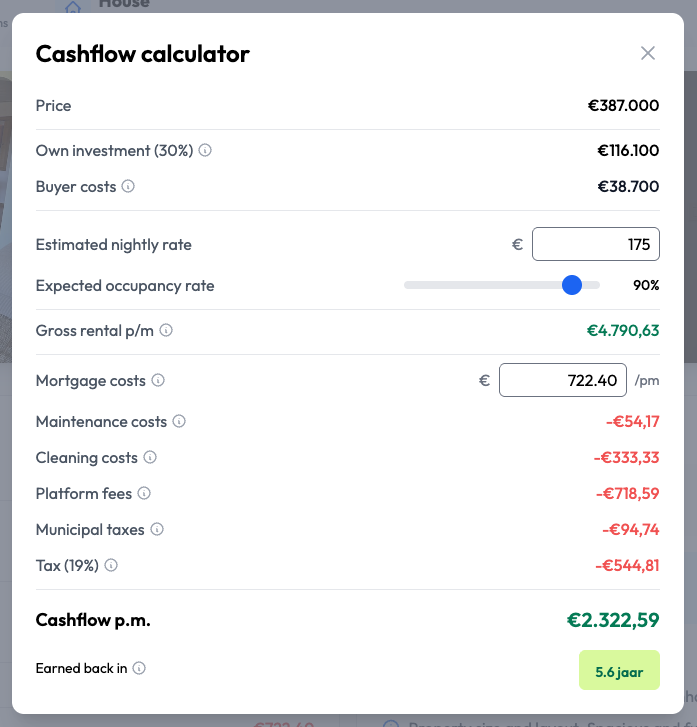
Using occupancy of 90% and a EUR 175 nightly rate, SpotEstate recalculated projected cashflow to EUR 2,322.59 per month.
At EUR 250 nightly rate and 90% occupancy, projection increased to EUR 3,736.17 per month, showing how assumptions drive outcomes.
Most important outcomes from this case study.
Baseline model provides a risk-aware foundation instead of overpromising returns.
Scenario modeling clearly shows upside potential when properties are professionally managed.
Investors can evaluate deals with confidence, then stress-test outcomes with transparent assumptions.
Key takeaways from this case study.
The largest risk for investors is often unrealistic expectations—not conservatively modeled returns.
SpotEstate intentionally anchors on a conservative baseline; upside is explored through scenarios, not the default headline.
Active revenue management and visibility in search can materially outperform area-average occupancy and nightly rates—as this property demonstrates.
Transparent, adjustable assumptions let investors compare properties objectively and decide faster.
Complete write-up with structured highlights and visual placeholders.
SpotEstate analyzed a real short-term rental property in Tenerife, Spain to validate the reliability of its cash flow predictions. The property is most of the time fully booked throughout the year and has an occupancy rate close to 90% and charges 175 euro per night in May. The owners of this property use dynamic pricing. If there are more empty spots, the nightly rate becomes lower. If there are less empty spots, it becomes higher.
SpotEstate analysed the property and retrieved a 70% average occupancy rate from the local area (city) and a €101 nightly rate with €121 at max in the high season. With these two variables the calculated cashflow is €513,92 per month. SpotEstate aggregates the data and calculates these averages.
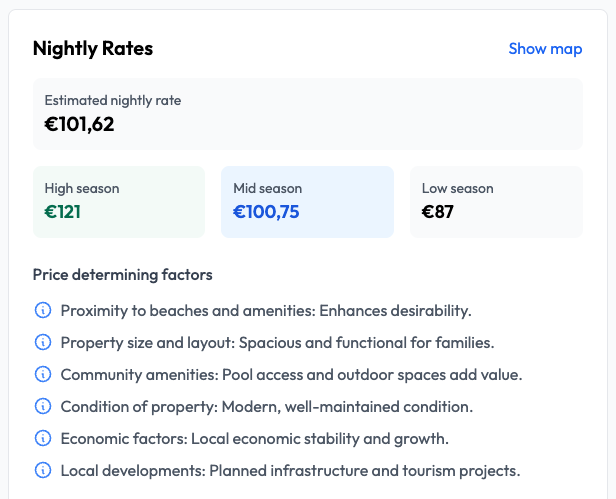
In reality, the property generates between €1800-2400 net per month (shared by the owner) due to the fact that they rank highly on the first page in the search results for this area. They also use advanced revenue management strategies, including dynamic pricing.
So that means that SpotEstate’s estimate is too low?
Here is the interesting part: SpotEstate allows users to simulate different scenarios by adjusting the occupancy rate and nightly rate. For this specific property, the analysis indicates a performance higher than the initial projection. To reflect this high-performing scenario, users can modify the occupancy and nightly rates within the platform.
When adjusting the occupancy rate to 90% and the nightly rate to 175 euros, SpotEstate makes the following calculation:
Key takeaway: SpotEstate provides conservative and reliable income estimates that investors can safely use as a baseline when evaluating real estate deals.
Many real estate projections fail because they rely on best-case scenarios. This causes disappointment.
SpotEstate takes a different approach.
The platform is designed to provide:
This conservative methodology helps investors avoid overestimating returns and reduces investment risk.
This means when you look at our cashflow projections, you can be sure that it has more potential.
We recommend you to calculate different scenarios using our calculator tool.

For real estate investors, the biggest risk is not low returns, it is unrealistic expectations.
A reliable baseline allows investors to:
The purpose of this case study was to test a critical question for real estate investors:
How reliable are SpotEstate's rental income predictions compared to real-world performance?
Rather than using hypothetical data, this analysis compares a real property with actual operating results.
Location: Tenerife, Spain Property Type: Short-term rental apartment Management Style: Active revenue management Owner: Priscilla
Priscillas operate her property using a professional hosting strategy, including:
Because of this proactive management approach, the property performs above the market average. According to performance data from major booking platforms, this property would be considered a high-performing outlier compared to similar listings in the same area. This distinction is important, as it explains why the actual income significantly exceeds the conservative baseline scenario used by SpotEstate.
SpotEstate generated its income estimate using verified short-term rental market data and standardized assumptions designed to reflect a realistic investor scenario.
The income model was based on aggregated data from:
The analysis used a dataset of comparable short-term rental properties in the same region with similar characteristics, including:
This approach ensures that estimates are based on real market behavior rather than optimistic assumptions.
SpotEstate intentionally uses a conservative baseline to protect investors from overly optimistic projections.
Nightly Rate: €101,62 Occupancy Rate: 70% Pricing Strategy: Standard market pricing
= €513,92
2. Second Scenario (Using the same nightly rate as the property)
Nightly Rate: €175 (still conservative!) Occupancy Rate: 90% Pricing Strategy: Active optimization
= €2322,59
Let’s take a look at the nightly rates from comparable accommodations in the area:
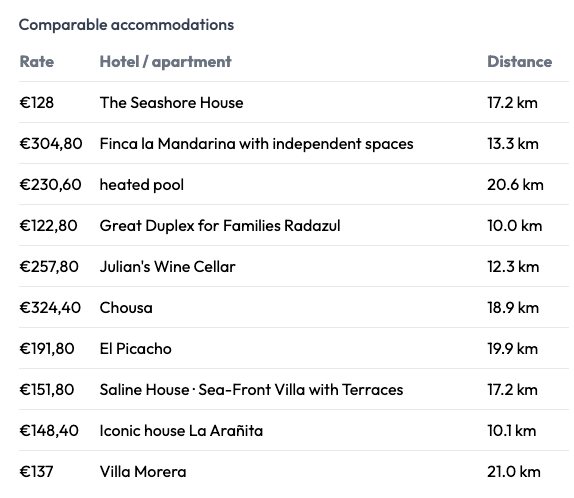
As you can see €175 is still conservative as a nightly rate but if you calculate it together with 90% occupancy rate, the property earns €2400 (net).
The increased revenue was primarily driven by:
These factors demonstrate the upside potential when a property is professionally managed.
SpotEstate does not predict the maximum possible income (although you can calculate this scenario yourself using our calculator).
It predicts a reliable baseline.
This distinction is critical for investment decision-making.
This case study demonstrates that SpotEstate provides conservative and reliable income estimates based on real market data and transparent assumptions.
The platform is intentionally designed to protect investors from overly optimistic projections while clearly showing the potential upside when properties are actively managed.
In practice, this means investors can use SpotEstate as a safe baseline for evaluating real estate deals and make investment decisions with confidence.
Every property on SpotEstate is supported by verified agencies, expert guidance, and a transparent purchase process.